

National Sports Stadium Upgrade Nears Completion, Minister Says

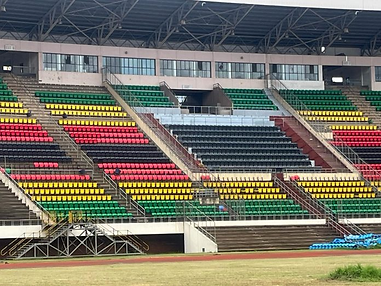
The rehabilitation of Harare’s National Sports Stadium is now in its final phase, with bucket seats, turnstiles and water-reticulation works almost complete, Sport Minister Anselem Nhamo Sanyatwe announced on 13 September. The government is racing to ready Zimbabwe’s flagship venue ahead of crucial World Cup qualifiers.
Sanyatwe confirmed that 98 percent of the 60,000 bucket seats have been installed, while electronic turnstiles and entry gates are 95 percent fitted. The pitch has undergone a total overhaul, including modern drainage and irrigation systems. With grass seeding already underway, the surface is expected to be match-ready by late November. A 505,000-litre water reservoir has also been rehabilitated to support maintenance.
“The pitch has been totally revamped with modern drainage and irrigation—this will end years of match postponements,” Sanyatwe said.
Closed to international fixtures since 2021 after CAF flagged non-compliance, the stadium’s upgrades also include LED floodlights sourced from South Africa, a nearly complete generator house (90%), and the demolition of outdated ablution blocks (99% complete). Dressing rooms, doping-control areas and media facilities are being redesigned to meet global event standards.
However, Finance Minister Mthuli Ncube’s Mid-term Budget Review in August highlighted delays—then noting turf works were only at 40 percent. Analysts warn that any further slippage could force Zimbabwe’s national football team to host home games abroad again, adding logistical and financial strains.
A Zimbabwe Football Association (ZIFA) official told reporters: “We’re monitoring each milestone. If the grass fails to establish by November, we’ll have to secure alternate venues in South Africa, adding travel burdens for players and supporters.”
Economic and Sporting Stakes
The stadium overhaul, backed by a US $12 million package from government funds and a CAF solidarity loan, is expected to restore annual match-day revenue of around US $2 million. Harare hoteliers already report a 30 percent rise in advance bookings for October and November, while local businesses anticipate a significant boost from tourism and hospitality.
Sports economist Dr. Rita Chikema emphasised the broader impact: “Stadium readiness is crucial not just for national pride but for fiscal multipliers—ticket sales, advertising and vendor income ripple through the economy.”
Inaugurated in 1987 for the All-Africa Games, the stadium fell into disrepair after decades of underfunding. CAF’s 2024 inspection warned Zimbabwe risked losing its home-ground advantage permanently without urgent reform.
The refurbishment campaign launched in early 2025 under a memorandum of understanding between the Ministry of Sport, the Ministry of Finance and ZIFA. Upcoming priorities include turf seeding, testing the LED floodlights, and completing gate integrations by 15 October. A final FIFA and CAF inspection is scheduled for 1 December.
If timelines hold, Zimbabwe will welcome international football back to Harare for its 2026 World Cup qualifiers against Benin and Rwanda, marking the stadium’s long-awaited return as the country’s sporting hub.


Comments